
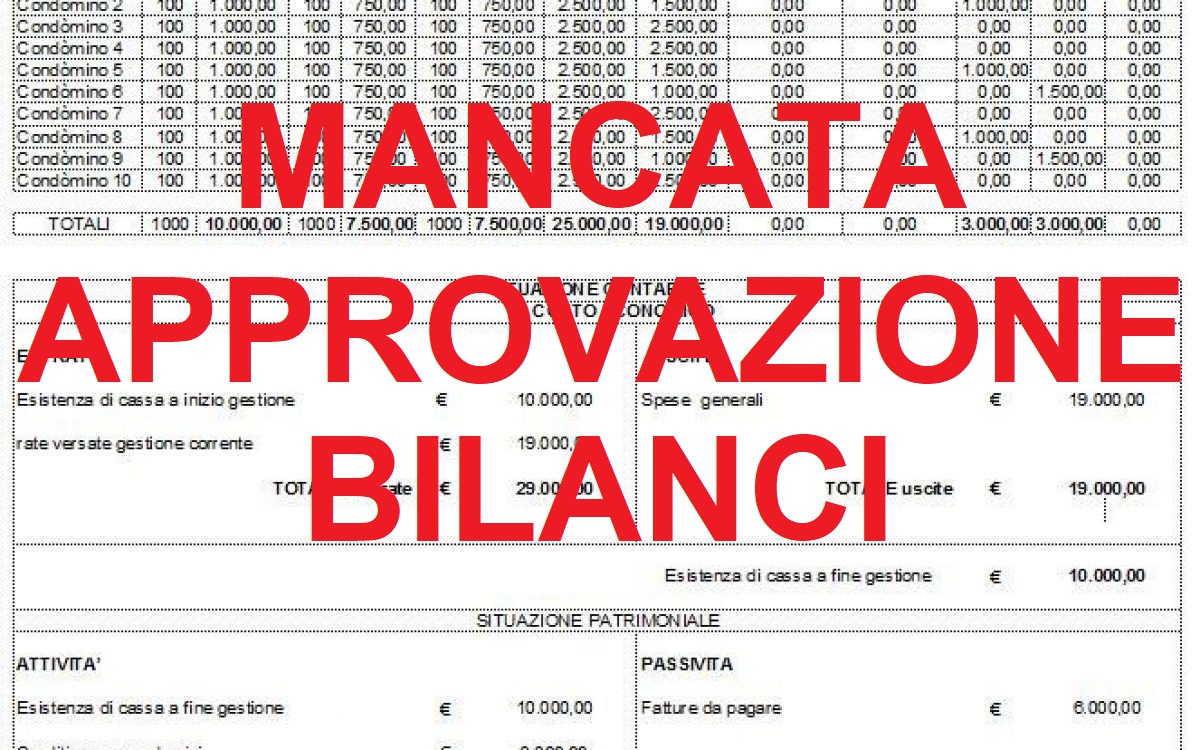
[:it]Conseguenze della mancata approvazione dei bilanci.[:en]Consequences of the non-approval of the financial statements.[:]
pubblicato: domenica, 14 Agosto, 2022
[:it]
Conseguenze della mancata approvazione dei bilanci.
Cosa succede se l’assemblea non acconsente al preventivo o al consuntivo presentati dall’amministratore?
Avv. Gianfranco Di Rago 10/08/2022
Preventivo e consuntivo sono due documenti contabili la cui redazione è di competenza dell’amministratore e che devono essere approvati dall’assemblea. Essi sono di fondamentale importanza per la gestione del condominio e, per quanto collegati, hanno funzioni diverse.
Il preventivo è lo strumento attraverso il quale l’amministratore chiede ai condomini il versamento in anticipo delle somme occorrenti per la gestione delle parti comuni, ovvero per affrontare le spese di manutenzione ordinaria ed eventualmente straordinaria, nonché per la conduzione dei servizi condominiali.
L’amministratore redige pertanto il documento nel quale indica le somme che ritiene necessarie per portare avanti fattivamente la gestione condominiale e ne chiede l’approvazione all’assemblea.
La cadenza annuale della gestione finanziaria del condominio è prevista direttamente dalla legge (artt. 1135, comma 2, n. 1, c.c. e 66, comma 1, Disp. att. c.c.).
Ai sensi del comma 1, n. 10, dell’art. 1130 c.c. l’amministratore deve poi rendere il conto annuale della propria gestione, convocando a tal fine l’assemblea entro 180 giorni. Anche in questo caso, come previsto dall’art. 1135, comma 1, n. 3, c.c., è l’assemblea a dover provvedere all’approvazione del rendiconto annuale dell’amministratore.
Il rendiconto è sicuramente uno degli obblighi più importanti dell’amministratore nei confronti del condominio, in quanto esso rappresenta lo strumento attraverso il quale viene reso noto ai condomini il modo in cui sono state impiegate le somme che questi hanno messo a sua disposizione per la gestione condominiale.
L’amministratore, ove richiesto dai condomini, deve anche mettere a loro disposizione i documenti relativi agli esborsi sostenuti durante l’anno e indicati nel consuntivo (le c.d. pezze giustificative).
Infatti, come previsto in via generale per il mandato dall’art. 1713 c.c. chi gestisce un bene altrui ha l’obbligo di rendiconto, dovendo rendere al mandante il conto del suo operato e rimettergli tutto ciò che ha ricevuto a causa di esso.
L’approvazione del rendiconto da parte del mandante ha quindi la funzione di certificare l’adempimento del mandatario al contratto di mandato e attribuire certezza al saldo contabile, che diviene così oggetto di obbligazione di una parte nei confronti nell’altra, nel senso che dall’approvazione del conto di un’attività di amministrazione possono scaturire obbligazioni di pagamento e/o di consegna di beni acquisiti o strumentali all’amministrazione, a carico e a favore di ognuna delle parti.
La mancata approvazione del consuntivo e/o del preventivo.
In ragione della diversa funzione svolta dai predetti documenti contabili è ovvio che differenti siano anche le conseguenze della loro mancata approvazione da parte dell’assemblea.
Cominciamo per semplicità dall’ipotesi della mancata approvazione assembleare del consuntivo. Occorre a questo proposito specificare che questa circostanza può verificarsi sostanzialmente per due ordini di motivi.
In primo luogo può trattarsi di un semplice incidente di percorso, laddove all’assemblea manchino i numeri per procedere all’approvazione del documento contabile.
Infatti, per quanto per l’approvazione del consuntivo e del preventivo sia sufficiente la maggioranza semplice, quindi il voto favorevole della maggioranza dei presenti all’assemblea che rappresenti almeno 1/3 del valore millesimale dell’edificio, può anche avvenire che alla riunione non sia presente un numero di condomini tale da raggiungere detto quorum.
In questo caso, come detto, si tratta semplicemente di un episodio isolato, che potrà essere agevolmente risolto con la convocazione di una nuova assemblea, nella quale raccogliere il numero di voti necessario per la legittima approvazione del consuntivo.
E infatti evidente che un consuntivo approvato senza la maggioranza prevista dalla legge sarebbe annullabile dai condomini che abbiano votato contro e da quelli assenti nei successivi 30 giorni, decorrenti dall’assemblea per i primi e dal ricevimento del verbale per i secondi.
Maggiormente problematica è invece la seconda ipotesi, ossia quella in cui l’assemblea, pur avendo una maggioranza sufficiente per approvare il consuntivo, bocci il documento predisposto dall’amministratore. In questo caso, infatti, vista la funzione del consuntivo, che è sostanzialmente quella di validare l’attività di gestione svolta dall’amministratore, è evidente come la mancata approvazione di essa renda manifesta la perdita di quel rapporto di fiducia tra compagine condominiale e amministratore, fatto che dovrebbe portare quest’ultimo a rassegnare le dimissioni o che dovrebbe comunque spingere l’assemblea a nominare un nuovo amministratore (anche se in questo caso, come è noto, è necessaria una maggioranza qualificata, ossia la maggioranza dei presenti che rappresenti almeno i 500 millesimi del valore dell’edificio).
In questi casi la mancata approvazione del consuntivo predisposto dall’amministratore sarà difficilmente sanabile con una nuova votazione. Infatti, molto probabilmente, ove l’amministratore restasse in carica e portasse all’esame dell’assemblea lo stesso identico consuntivo, lo stesso sarebbe di nuovo bocciato.
Vi è però anche la possibilità, ove si tratti di contestazioni circoscritte, che l’amministratore faccia ammenda e provveda a presentare a una nuova assemblea il rendiconto corretto, che potrebbe quindi essere approvato.
In caso contrario, ove si provveda alla sostituzione dell’amministratore, generalmente viene dato incarico al nuovo mandatario di verificare la contabilità condominiale e portare all’esame dell’assemblea un nuovo documento contabile, ferme eventuali responsabilità del precedente amministratore.
Ancora più complessa è poi l’ipotesi in cui l’assemblea bocci il preventivo formulato dall’amministratore. Anche in questo caso quest’ultimo potrebbe comunque valutare di accogliere le richieste sottese alla mancata approvazione del documento contabile e presentare in una nuova assemblea un diverso preventivo per ottenerne l’approvazione.
In caso contrario è evidente come la mancanza di un preventivo pregiudichi seriamente la possibilità per l’amministratore di raccogliere i fondi indispensabili per la gestione dei beni e dei servizi comuni. Si potrebbe ricorrere a una soluzione tampone.
La giurisprudenza infatti ammette che l’assemblea, in attesa dell’approvazione del bilancio preventivo, possa autorizzare l’amministratore a richiedere ai condomini dei pagamenti provvisori, con riserva di successivo conguaglio sulla base del bilancio approvato e tenuto conto dei valori millesimali attribuiti a ciascuna proprietà individuale (si veda sul punto Cass. civ., sezione seconda, 27 marzo 2003, n. 4531).
Tuttavia occorre uscire velocemente dall’impasse.
Ecco perché, ferma sempre la possibilità per l’amministratore di rinunciare al mandato per giusta causa, l’unico strumento possibile pare essere quello del ricorso dei condomini alla volontaria giurisdizione ai sensi dell’art. 1105, ultimo comma, c.c., per la richiesta al Tribunale di un provvedimento utile e necessario alla prosecuzione della gestione annuale del condominio.
Fonte: https://www.condominioweb.com/conseguenze-della-mancata-approvazione-dei-bilanci.19611#2
GECOSEI di Giuseppina Napolitano

[:en]
Consequences of the non-approval of the financial statements .
What happens if the assembly does not agree to the budget or the final balance presented by the administrator?
Attorney Gianfranco Di Rago 08/10/2022
Estimate and final balance are two accounting documents whose preparation is the responsibility of the administrator and which must be approved by the assembly. They are of fundamental importance for the management of the condominium and, although connected, they have different functions.
The estimate is the tool through which the administrator asks the condominiums to pay in advance the sums necessary for the management of the common parts, or to face the costs of ordinary and possibly extraordinary maintenance, as well as for the condominium services.
The administrator therefore draws up the document in which he indicates the sums he deems necessary to effectively carry out the condominium management and asks the assembly for approval.
The annual frequency of the financial management of the condominium is provided directly by law (articles 1135, paragraph 2, n. 1, cc and 66, paragraph 1, Act. Act. Cc).
Pursuant to paragraph 1, no. 10, of the art. 1130 cc . the administrator must then return the annual accounts of his own management, calling the meeting for this purpose within 180 days. Also in this case, as required by art. 1135, paragraph 1, n. 3, cc, it is the assembly that must approve the director’s annual report.
The report is certainly one of the most important obligations of the administrator towards the condominium, as it represents the tool through which the condominiums are made known how the sums they have made available for management have been used. condominium.
The administrator, if requested by the condominiums, must also make available to them the documents relating to the disbursements incurred during the year and indicated in the final balance (the so-called supporting documents).
In fact, as provided in general for the mandate by art. 1713 cc whoever manages another’s property has the obligation to report, having to give the principal an account of his work and remit him everything he has received as a result of it.
The approval of the report by the principal therefore has the function of certifying the fulfillment of the mandate by the mandate contract and attributing certainty to the accounting balance, which thus becomes the object of an obligation by one party to the other, in the sense that from Approval of the account of an administration activity may give rise to obligations of payment and / or delivery of assets acquired or instrumental to the administration, to be borne by and in favor of each of the parties.
Failure to approve the final balance and / or estimate.
Due to the different function performed by the aforementioned accounting documents, it is obvious that the consequences of their lack of approval by the shareholders’ meeting are also different.
Let’s start for simplicity with the hypothesis of the non-approval of the final balance sheet. In this regard, it should be specified that this circumstance can substantially occur for two reasons.
In the first place, it may be a simple hiccup, where the assembly lacks the numbers to proceed with the approval of the accounting document.
In fact, although a simple majority is sufficient for the approval of the final balance and the budget, therefore the favorable vote of the majority of those present at the assembly representing at least 1/3 of the thousandth value of the building, it may also happen that at the meeting no there is a number of condominiums such as to reach said quorum.
In this case, as mentioned, it is simply an isolated episode, which can be easily resolved with the convocation of a new assembly, in which to collect the number of votes necessary for the legitimate approval of the final balance.
It is in fact evident that a final balance approved without the majority required by law would be voidable by condominiums who voted against and by those absent in the following 30 days, starting from the assembly for the former and from receipt of the minutes for the latter.
The second hypothesis, on the other hand, is more problematic, namely that in which the assembly, despite having a sufficient majority to approve the final balance, rejects the document prepared by the administrator. In this case, in fact, given the function of the final balance, which is essentially that of validating the management activity carried out by the administrator, it is evident that the lack of approval of it makes manifest the loss of that relationship of trust between the condominium and the administrator. , a fact that should lead the latter to resign or that should in any case push the assembly to appoint a new director (even if in this case, as is known, a qualified majority is required, i.e. the majority of those present representing at least 500 thousandths of the value of the building).
In these cases, the failure to approve the final balance prepared by the administrator will be difficult to remedy with a new vote. In fact, most likely, if the administrator remained in office and brought the exact same final balance to the examination of the assembly, the same would be rejected again.
However, there is also the possibility, in the case of limited disputes, that the director makes amends and presents the correct report to a new meeting, which could then be approved.
Otherwise, if the administrator is replaced, the new agent is generally given the task of checking the condominium accounting and bringing a new accounting document to the examination of the assembly, without prejudice to any responsibilities of the previous administrator.
Even more complex is the hypothesis in which the assembly rejects the budget formulated by the administrator. Also in this case, the latter could still consider accepting the requests underlying the non-approval of the accounting document and present a different estimate in a new meeting to obtain approval.
Otherwise it is evident that the lack of an estimate seriously jeopardizes the possibility for the administrator to raise the funds necessary for the management of common goods and services. A buffer solution could be used.
In fact, jurisprudence admits that the assembly, pending the approval of the budget, may authorize the administrator to request provisional payments from the condominiums, subject to subsequent adjustment on the basis of the approved budget and taking into account the thousandth values attributed to each individual property (see on the point Civil Court, second section, March 27, 2003, n. 4531).
However, we need to get out of the impasse quickly.
This is why, without prejudice to the possibility for the administrator to renounce the mandate for just cause, the only possible tool seems to be that of the use of the condominiums to the voluntary jurisdiction pursuant to art. 1105, last paragraph, of the Italian Civil Code, for the request to the Court for a useful and necessary measure for the continuation of the annual management of the condominium.
Source: https://www.condominioweb.com/conseguenze-della-mancata-appapproval-dei-bilanci.19611#2
GECOSEI by Giuseppina Napolitano
[:]